
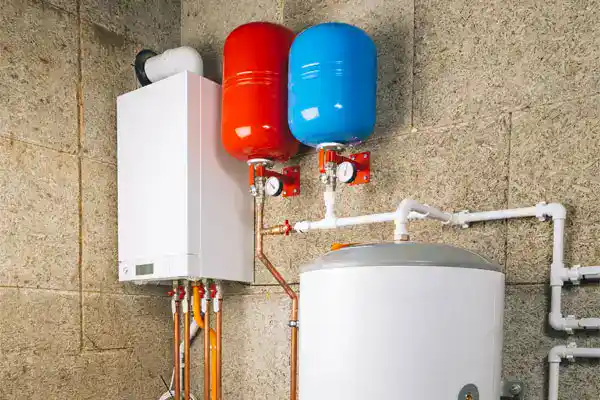
A boiler expansion tank gives the water in your heating system room to expand as it heats up. Without it, pressure would climb every time the boiler fires. When an expansion tank fails, the most common sign is a pressure relief valve that drips or releases water, along with a pressure gauge that swings high when the boiler runs.
How an Expansion Tank Works
Water expands when it’s heated. In a closed hot water heating system, that extra volume has to go somewhere. Most modern expansion tanks have a rubber diaphragm inside, with air on one side and system water on the other. As the water expands, it pushes against the diaphragm and compresses the air cushion. When the water cools, the air pushes it back.
Older homes may have a plain steel tank hung from the basement ceiling, with no diaphragm. These rely on a pocket of air at the top of the tank and work a little differently, but the purpose is the same.
Signs Your Expansion Tank Is Failing
- The relief valve drips or discharges water. This is the most common sign.
- Pressure swings. The gauge reads normal when the boiler is cold, then climbs high when it’s running.
- The tank sounds full. Tap the tank. A good diaphragm tank sounds hollow at the top. A waterlogged tank sounds solid all the way up.
- Water comes out of the air valve. If pressing the valve on the tank releases water instead of air, the diaphragm has failed.
- Banging or gurgling in the pipes.
Why It Matters
A failed expansion tank puts extra stress on the boiler, pipes, fittings, and relief valve. Repeated relief valve discharges can wear out the valve and lead to leaks. Water released by the relief valve also has to be replaced with fresh water, which brings in oxygen and minerals that can speed up corrosion inside the system.
Never cap or plug a relief valve that’s dripping. It’s a safety device.
Can It Be Fixed?
- Low air charge: A diaphragm tank that has lost some air can sometimes be recharged to the correct pressure. This needs to be done with the system pressure relieved and matched to the boiler’s fill pressure.
- Failed diaphragm: Replace the tank.
- Waterlogged steel tank: It can be drained so the air pocket is restored, though older systems may benefit from switching to a diaphragm tank.
Tank replacement is usually a straightforward repair, but it involves draining pressure from the system, so it’s a job for a technician.
Check It Every Year
The expansion tank, relief valve, and system pressure should all be checked during a yearly boiler tune-up. Catching a failing tank early prevents relief valve problems in the middle of winter.
Get Your Boiler Checked
Auchinachie Services has worked on hot water heating systems in Binghamton and the Southern Tier since 1906. Our licensed technicians check expansion tanks, relief valves, and system pressure and explain any repairs with upfront pricing. Learn more about our boiler services.